Material guide
Concrete & brick
What works on concrete, brick and block: the right drill, bit, blade, screw anchor and adhesive, plus OSHA's silica dust controls for each job.
Quick facts
- Strength
- About 2,500 psi for home concrete to 4,000 psi and up in commercial work, tested at 28 days
- Best drill
- Hammer drill for a few small holes; rotary hammer (SDS-plus) for many or bigger holes
- Best bit
- Carbide-tipped masonry bit
- Best blade
- Diamond blade, cut wet
- Screw anchors
- Tapcon-type: 5/32 in hole for 3/16 in screws, 3/16 in hole for 1/4 in screws, 1 to 1-3/4 in deep
- Dust hazard
- Contains crystalline silica. OSHA Table 1 sets the dust control for each tool.
Concrete is cement, sand, gravel and water that cure into stone. Brick is fired clay, laid in mortar. Concrete block is somewhere in between: hollow and lighter, with thin walls. All three are hard, gritty and heavy on tools.
That's what makes them tricky. A plain drill bit just spins and burns. You need a carbide tip and a tool that hammers as it turns. Hidden rebar can stop a bit cold. Expansion anchors push outward, so near an edge they can crack the concrete or brick. Screw anchors don't.
Anchors need care too. A concrete screw holds by cutting threads into the hole wall. If the hole is the wrong size or full of dust, it strips or won't go in.
Every one of these jobs makes silica dust. That's the biggest hazard, so plan your dust control before you start.
Drill into concrete & brick
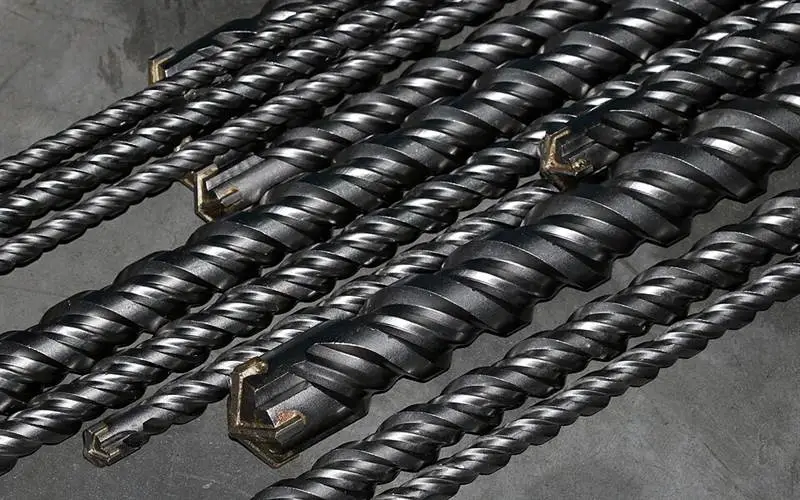
Use a carbide-tipped masonry bit with hammer action on. A hammer drill handles a few small holes. For many holes or bigger ones, use a rotary hammer with SDS-plus bits. Fit a dust shroud with a vacuum, and vacuum out the hole before you set an anchor.
What to use: Rotary hammer + carbide SDS-plus bit
Guides
- How to remove a broken drill bit from metal, wood or concrete
- How to drill a 4-inch hole in a concrete foundation wall
- How to drill into concrete (with and without a hammer drill) (coming)
- How to drill into brick (coming)
- Can you drill concrete with a regular drill? (coming)
- Hammer drill vs rotary hammer vs impact driver (coming)
- Masonry bit stopped dead: did you hit rebar? (coming)
- SDS-plus vs SDS-max vs round shank (coming)
Cut concrete & brick
Use a diamond blade on a circular saw, cut-off saw or angle grinder made for it. Cut wet: OSHA's silica rule calls for a saw with a built-in water feed. Make shallow passes and let the blade cut.
What to use: Diamond blade with water feed
Guides
- How to sharpen a diamond blade (dress it, don't grind it)
- How to remove tile from a concrete floor (and the thin-set under it)
- How to cut concrete and pavers (coming)
- Angle grinder disc types: metal, tile, concrete, flap, wire (coming)
Glue concrete & brick
To stick wood, stone or metal to concrete or brick, use a polyurethane construction adhesive on clean surfaces. For small repairs, a two-part epoxy bonds concrete and brick. Clean off dust and loose bits first, or the glue grabs the dust, not the wall.
What to use: Polyurethane construction adhesive
Guides
- Adhesive for wood or metal to concrete (coming)
- Liquid Nails vs PL Premium vs Gorilla construction adhesive (tested) (coming)
- Bond new concrete to old concrete (coming)
- Remove construction adhesive from drywall, concrete, and wood (coming)
Screw or anchor into concrete & brick
Use concrete screws like Tapcons. Drill with a hammer drill and the carbide bit the screw calls for, at least 1/2 in deeper than the screw goes. Clean the hole out. Embed the screw 1 to 1-3/4 in. In brick, you can drill the brick or the mortar joint.
What to use: Tapcon-type screw + matching carbide bit
Guides
- Screw won't go into the wall? Find the cause and fix it
- Concrete and brick anchors explained: Tapcon, sleeve, wedge, drop-in, epoxy (coming)
- Tapcon won't go all the way in (or snapped): causes and fixes (coming)
- Tapcon drill bit size chart (5/32 vs 3/16) and depth (coming)
- Should you drill into the brick or the mortar? (coming)
- Can you screw directly into concrete? (coming)
- How to hang things on brick without drilling (coming)
- How to remove a broken Tapcon (coming)
Sand or finish concrete & brick
Grind concrete with a diamond cup wheel on an angle grinder, not sandpaper. OSHA calls for a grinder with a water feed, or a shroud hooked to a dust collector. To clean brick and concrete, a pressure washer does the job; match the PSI to the surface.
What to use: Diamond cup wheel with a dust shroud
Guides
- Pressure washer nozzle colors explained (and which one for which surface) (coming)
- What PSI for a car, deck, driveway, and siding (coming)
Safety basics
- Control silica dust. OSHA's silica rule lists a control for each tool: a shroud with a vacuum for drills, a water feed for saws.
- Wear safety glasses. Chips and grit fly off the bit and blade.
- Brace the drill. A rotary hammer can twist hard if the bit binds on rebar. Use the side handle.
- Mind the blade. Only use a diamond blade rated for your saw's speed, with the guard on.
Sources
- CIP 35: testing compressive strength of concrete, 2,500 psi residential to 4,000 psi and higher commercial (NRMCA)
- Cement and concrete FAQ: strength measured at 28 days (American Cement Association)
- Drilling concrete? Get a rotary hammer (Fine Homebuilding)
- SDS-plus Bulldog rotary hammer drill bits: carbide tip (Bosch)
- Tapcon screws in brick: hole sizes, 1 in minimum and 1-3/4 in maximum embedment, drill 1/2 in deeper, clean the hole, hammer drill (Confast)
- Genuine Tapcon screw anchors: no expansion, so they can go near concrete's edge (ITW Buildex)
- LOCTITE PL Premium construction adhesive technical data sheet: bonds concrete, masonry, brick, wood, metal (Henkel)
- J-B Weld Original twin tube: bonds concrete and brick; clean, degrease and roughen first (J-B Weld)
- 29 CFR 1926.1153, Respirable crystalline silica (construction), Table 1: saws, drills and grinders (OSHA)
- Control of silica dust in construction: handheld grinders for tasks other than mortar removal, FS-3628 (OSHA)
- OSHA 29 CFR 1910.133: eye and face protection