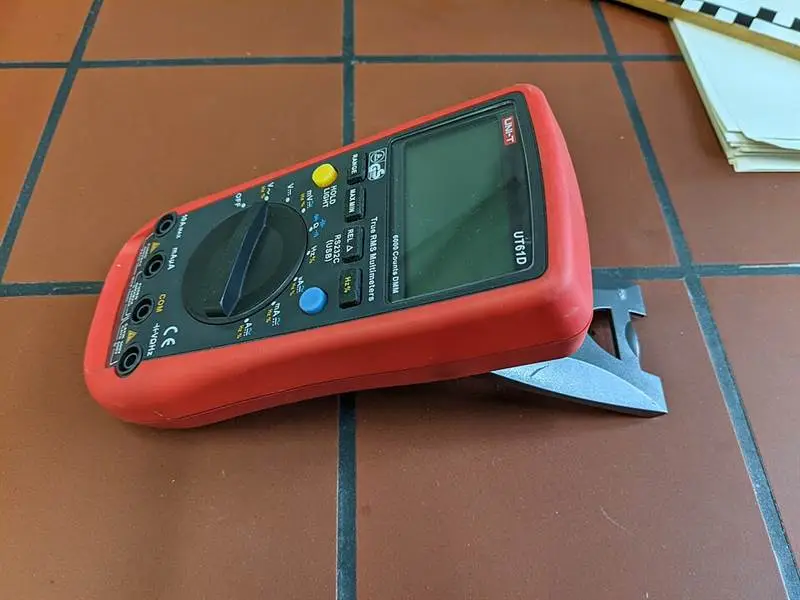
Klein MM700 multimeter: specs, CAT ratings and who it suits
In this guide
- What is the Klein MM700?
- Klein MM700 specs at a glance
- What the CAT rating means for you
- True RMS and LoZ, in plain words
- Who the MM700 suits (and who it doesn't)
- MM700 vs MM400, MM600 and Fluke 115/117
- How to use the key functions safely
- If the MM700 reads wrong or reads zero
- Where the MM700 fits
- What you'll need
- Questions people ask
What is the Klein MM700?
The MM700 is a handheld digital multimeter from Klein Tools. Klein calls it an auto-ranging True RMS meter. It reads AC and DC volts, AC and DC amps, and resistance. It can also check temperature, capacitance, frequency, duty cycle, diodes and continuity.
Two things set it apart in Klein's line. One is True RMS, which gives correct AC readings on messy waveforms, not just clean ones. The other is a low impedance (LoZ) setting for ghost voltage.
Klein has since stopped making it. Its product page says it is no longer in production, and distributors name the MM720 as the direct replacement. Many MM700s are still on store shelves and in used listings, so it's worth knowing what you're getting.
New to meters? Start with how to use a multimeter, then come back.
Klein MM700 specs at a glance
All figures are from the MM700 instruction manual unless noted.
| Spec | Klein MM700 |
|---|---|
| Safety rating | CAT IV 600V, CAT III 1000V, double insulated |
| AC/DC voltage | Up to 1000V |
| AC/DC current | Up to 10A (μA and mA ranges too) |
| Resistance | Up to 40 MΩ |
| Capacitance | Up to 4000 µF |
| Frequency | Up to 500 kHz |
| Temperature | 0 to 1500°F (-18 to 816°C), K-type probe |
| DC volts accuracy | ±(1.0% + 3 digits) on the 4V to 400V ranges |
| Display | 4000-count LCD, backlight, 41-segment bar graph |
| Extra modes | LoZ, data hold, range hold, min/max, relative |
| Continuity beep | Below 50 Ω |
| Drop rating | 6.6 ft (2 m) |
| Dust and water | IP42 (not the lead jacks) |
| Battery | 2 × AAA |
| Auto power off | About 30 minutes; backlight off after 3 minutes |
| Size and weight | 7.02 × 3.54 × 2.10 in (178 × 90 × 53 mm), 14.6 oz (414 g) |
| Warranty | 2 years from purchase (Klein warranty catalog) |
What the CAT rating means for you
A CAT rating tells you where on a power system a meter can safely take a voltage spike. The higher the category, the closer to the power source you can work.
- CAT II: plug-in loads and outlets far from the panel.
- CAT III: the panel, feeders and short branch circuits.
- CAT IV: the service entrance, the meter base and outdoor lines.
The MM700 is rated CAT IV at 600V and CAT III at 1000V. For checking a tool battery, a cord or an outlet, that's far more than you need. It does not make panel or service work safe for someone who isn't trained for it.
The rating also only holds if the leads match. Klein's manual says to use only CAT IV rated test leads. Keep the lead shields on in CAT III and CAT IV spots. You may take them off for CAT II work, such as reaching into a wall outlet.
True RMS and LoZ, in plain words
True RMS. A basic meter assumes AC is a smooth wave. Many loads, like variable-speed tools, chargers and LED drivers, bend that wave. A True RMS meter reads those bent waves more accurately.
Klein's comparison chart lists True RMS on the MM700 but not on the MM600 or MM400. Note that the MM700's AC volts accuracy is stated for 50 to 400 Hz.
LoZ. In its normal voltage mode, the MM700 has a 10 MΩ input. That high input can pick up a "ghost" voltage on a dead wire that runs next to a live one.
In LoZ mode, the input drops to about 3 kΩ. A real voltage still shows. A ghost reading collapses. LoZ is limited to 600V.
Who the MM700 suits (and who it doesn't)
It's a good fit on paper if you:
- Want one meter for home, car, HVAC and shop work.
- Want a CAT IV rating, temperature and True RMS in one tool.
- Need to tell ghost voltage from real voltage on old wiring.
You may not need it if you:
- Only check tool batteries, fuses and extension cords. A simpler CAT III meter like the MM400 covers that.
- Want a built-in non-contact voltage detector. The MM700 doesn't have one.
- Need fine DC readings. Fluke lists tighter DC accuracy on the 117.
MM700 vs MM400, MM600 and Fluke 115/117
Here's how the MM700 stacks up on published specs. The Klein figures come from Klein's manuals and comparison chart. The Fluke figures come from Fluke's product pages.
| Spec | Klein MM400 | Klein MM600 | Klein MM700 | Fluke 115 | Fluke 117 |
|---|---|---|---|---|---|
| Safety rating | CAT III 600V | CAT IV 600V, CAT III 1000V | CAT IV 600V, CAT III 1000V | CAT III 600V | CAT III 600V |
| Max voltage | 600V | 1000V | 1000V | 600V | 600V |
| Max current | 10A | 10A | 10A | 10A | 10A |
| True RMS | No | No | Yes | Yes | Yes |
| LoZ mode | No | No | Yes | No | Yes |
| Non-contact detector | No | No | No | No | Yes |
| Display count | 4000 | 4000 | 4000 | 6000 | 6000 |
| Capacitance | 200 µF | 1000 µF | 4000 µF | 9,999 µF | 9,999 µF |
| Frequency | 50 kHz | 500 kHz | 500 kHz | 50 kHz | 50 kHz |
| Temperature | To 1000°F | To 1000°F | To 1500°F | Not in spec table | Not in spec table |
| Drop rating | 3.3 ft (1 m) | 6.6 ft (2 m) | 6.6 ft (2 m) | Not stated | Not stated |
| IP rating | None listed | IP42 | IP42 | Not stated | Not stated |
| Battery | 2 × AAA | 2 × AAA | 2 × AAA | 9V | 9V |
| Warranty | 2 years | 2 years | 2 years | 3 years | 3 years |
Klein MM600 vs MM700
The two are the same size, with the same 1000V and 10A limits and the same CAT IV 600V rating. The MM700 adds True RMS, LoZ and a bar graph. It also reaches 4000 µF and 1500°F, where the MM600 stops at 1000 µF and 1000°F. If you'll only test plain sine-wave power, the MM600 does most of the same jobs.
Klein MM400 vs MM700
The MM400 is smaller and lighter, at 8.1 oz (230 g). It tops out at 600V and CAT III 600V, and it's rated for a 3.3 ft (1 m) drop. For tool batteries, cords and outlets, that's often enough. Its DC volts accuracy is ±(1.2% + 3 digits) on the middle ranges, close to the MM700's ±(1.0% + 3 digits).
Klein MM700 vs Fluke 115 and 117
Fluke rates both the 115 and the 117 at CAT III 600V. Both are True RMS with a 6000-count display. The 117 adds LoZ, automatic AC/DC selection and Fluke's VoltAlert non-contact detector.
Fluke lists the 117's DC volts accuracy as ±(0.5% + 2 counts), about twice as tight as the MM700. The MM700 answers with a CAT IV rating, a 1000V range and temperature. Fluke's warranty is 3 years, one more than Klein's.
How to use the key functions safely
Check the meter first (live-dead-live)
Klein's manual says to check the meter on a known voltage before each use. NFPA 70E (2024, section 120.6) asks workers to check the tester on a known source before and after an absence-of-voltage test. OSHA 1910.333 also requires testing to verify that parts are dead.
- Read a known live outlet. You should see about 120V.
- Test the circuit or device you care about.
- Read the known outlet again. If it doesn't read now, your first "dead" reading can't be trusted.
For a full walk-through, see how to test live wires with a multimeter.
AC or DC voltage
- Red lead in VΩ, black lead in COM.
- Turn the dial to V. It starts in AC. Press SEL to switch to DC.
- Touch the probes to the circuit. A minus sign means the leads are reversed.
A few millivolts with the leads open is normal noise. For a cordless tool pack, see test a tool battery with a multimeter.
Ghost voltage check with LoZ
If a wire you've switched off still shows voltage, turn the dial to LoZ and test again. A ghost reading should drop to near zero. A real voltage stays. Never use LoZ above 600V.
Continuity and resistance
- Turn off the power first. Klein's manual says never to test resistance or continuity on a live circuit.
- Dial to the continuity/resistance/diode setting. It starts in continuity.
- Touch the probes across the cord, fuse or switch. A beep means less than 50 Ω. "OL" means open.
Press SEL once for resistance. Our continuity test guide shows how to check an extension cord end to end.
Current (amps)
The meter must go in series with the load, so this is the riskiest test for a beginner.
- Turn off the power and open the circuit where you'll measure.
- For 400 mA to 10A, use the 10A jack. Below 400 mA, use the mA/µA jack.
- Connect the meter in line, then turn the power back on.
Never go over 10A. Above 6A, Klein says to measure for 30 seconds, then rest the meter for 10 minutes.
If the MM700 reads wrong or reads zero
- Reads 0 on amps: a blown fuse is the usual cause. The mA jack takes a 500mA/1000V fast-blow fuse (Klein 69035). The 10A jack takes a 10A/1000V fast-blow fuse (Klein 69034). See Klein MM400/MM700 fuse replacement.
- Odd or jumpy readings: push the leads all the way into the jacks. The manual says a loose lead can give intermittent readings.
- Low-battery icon: replace both AAA cells right away. Klein warns that a low battery can cause false readings.
- Shows "OL": the reading is over range, or the circuit is open. See multimeter reads zero or OL.
Unplug the leads from any circuit before you open the battery and fuse door.
Where the MM700 fits
The MM700 sits near the top of Klein's older auto-ranging line, under the replacement MM720. On a tight budget? Our Cen-Tech multimeter guide covers Harbor Freight's low-cost meter.
If you have an old needle meter, see how to use an analog multimeter. To learn what each dial mark means, read multimeter symbols explained.
If you're chasing a dead battery pack, it helps to know what's inside. Our guide on how many cells are in a 12-volt battery shows the voltage you should expect. The battery runtime calculator turns amp-hours into run time. More meter and power guides live in the electrical hub, and every Klein guide is on the Klein brand page.
What you'll need
- Klein MM700 (or its replacement, the MM720): Check that the seller is an authorized dealer if you want the warranty
- CAT IV rated test leads: The manual says to use only CAT IV leads; keep the shields on in CAT III/IV spots
- 2 AAA batteries: Swap them as soon as the low-battery icon shows
- Spare fuses: 500mA/1000V (Klein 69035) and 10A/1000V (Klein 69034)
- A known live source: Such as a working outlet, to check the meter before and after a test
- Safety glasses: Plus insulated gloves where live parts are exposed
Key takeaways
- The MM700 is rated CAT IV 600V and CAT III 1000V. That is more than most home tool work needs, and it is only as safe as the leads you use with it.
- Its two big extras over the MM600 are True RMS and a LoZ mode. LoZ helps you tell a real voltage from a ghost reading on a dead wire.
- It runs on 2 AAA batteries, has a 4000-count display, and is rated for a 6.6 ft (2 m) drop and IP42.
- Klein lists the MM700 as discontinued and names the MM720 as its direct replacement. Check the warranty terms before you buy a leftover unit.
- Test your meter on a known live source before and after you check a circuit. NFPA 70E calls this out, and so does Klein's manual.
Questions people ask
Is the Klein MM700 discontinued?
Yes. Klein's product page says it is no longer in production, and distributors name the MM720 as the direct replacement. You can still find new and used MM700s for sale.
What's the difference between the Klein MM600 and MM700?
They are the same size, with the same 1000V and 10A limits, CAT IV 600V rating, drop rating and IP42 rating. The MM700 adds True RMS, a LoZ mode, a bar graph, a 4000 µF capacitance range and a higher 1500°F temperature limit.
Is the Klein MM700 better than a Fluke 117?
On paper they trade wins. The MM700 has the higher CAT rating (CAT IV 600V vs CAT III 600V), reads up to 1000V and measures temperature. The Fluke 117 has a 6000-count display, tighter DC accuracy, a built-in non-contact voltage detector and a 3-year warranty.
Does the Klein MM700 have a non-contact voltage tester?
No. Klein's manual does not list one. Some older reviews say it does. If you want one built in, look at the Fluke 117, or carry a separate pen-style tester.
What batteries does the Klein MM700 use?
Two AAA batteries. They sit behind the same screw-down door as the fuses. Pull the test leads off any circuit before you open it.
Can the Klein MM700 measure temperature?
Yes, from 0 to 1500°F (-18 to 816°C) with a K-type thermocouple. The probe in the box is rated only to 356°F (180°C), so buy a higher-rated probe for hotter work.
Sources
- Klein Tools MM700 instruction manual: specifications, warnings, functions, fuses (Klein Tools, hosted by The Home Depot)
- Digital Multimeter TRMS/Low Impedance, 1000V, MM700: product page (Klein Tools)
- Klein Tools multimeter comparison chart: MM700, MM600, MM400, MM300 (Klein Tools catalog page, hosted by Gescan)
- Klein Tools MM400 instruction manual: specifications (Klein Tools, hosted by UBC)
- Klein Tools MM700: discontinued, MM720 named as direct replacement (ITM distributor listing)
- Klein Tools warranty: electronic test and measurement devices, two years from purchase (Klein Tools catalog)
- Fluke 117 Electrician's True RMS Multimeter: specifications (Fluke)
- Fluke 115 True RMS Digital Multimeter: specifications (Fluke)
- Multimeter guide: what are CAT ratings? (Fluke)
- NFPA 70E, Standard for Electrical Safety in the Workplace (2024), 120.6: verifying absence of voltage (NFPA)
- 29 CFR 1910.333(b)(2)(iv)(B): verify de-energized parts with test equipment (OSHA)
Change log: Nov 6, 2026: Rewritten from the 2023 archive post as a spec-based guide. Removed untested 'review' and accuracy claims, the false built-in non-contact tester claim and the wrong Fluke 115 comparison; added manual specs, the MM400/MM600/Fluke table, discontinued status and safety steps.