How many cells are in a 12-volt battery?
In this guide
A 12-volt lead-acid battery has six cells, each making about 2.1 volts when full. Lithium 12-volt batteries use fewer, higher-voltage cells: four for LiFePO4 and three for most 12V power tool packs.
This guide is part of our electrical and power hub.
Cells by battery type
A cell is one unit that makes voltage. Cells in a row (in series) add their voltages. So the cell count depends on how many volts each cell makes.
| Battery type | Volts per cell | Cells for "12 volts" | Pack voltage |
|---|---|---|---|
| Lead-acid: flooded, AGM, gel (car, mower, motorcycle) | About 2.1 V when full | 6 | About 12.6 V full |
| LiFePO4 "12V" (boat, RV, drop-in lead-acid swap) | 3.2 V nominal | 4 | 12.8 V nominal |
| Lithium-ion 12V tool pack (DeWalt 12V MAX and similar) | 3.6 V nominal | 3 | 10.8 V nominal, "12V max" |
| NiMH or NiCd (older tool packs) | 1.2 V nominal | 10 | 12 V nominal |
Optima gives the 2.1 volts per lead-acid cell. Battle Born lists its 12V LiFePO4 batteries at 12.8 volts nominal, which is four 3.2-volt cells. DeWalt says its 12V MAX packs read 12 volts max with no load and 10.8 volts nominal. That's three lithium-ion cells at 3.6 volts each, the nominal voltage on Panasonic's cell data sheet.
How many cells in a car battery?
Six. Every 12-volt car battery, flooded or AGM, is six lead-acid cells joined in a row inside one case. On older flooded batteries, you can often see it: there are six fill caps, or two covers that each span three cells.
A 6-volt lead-acid battery, like some old tractors and golf carts use, has three cells.
What a healthy 12V battery reads
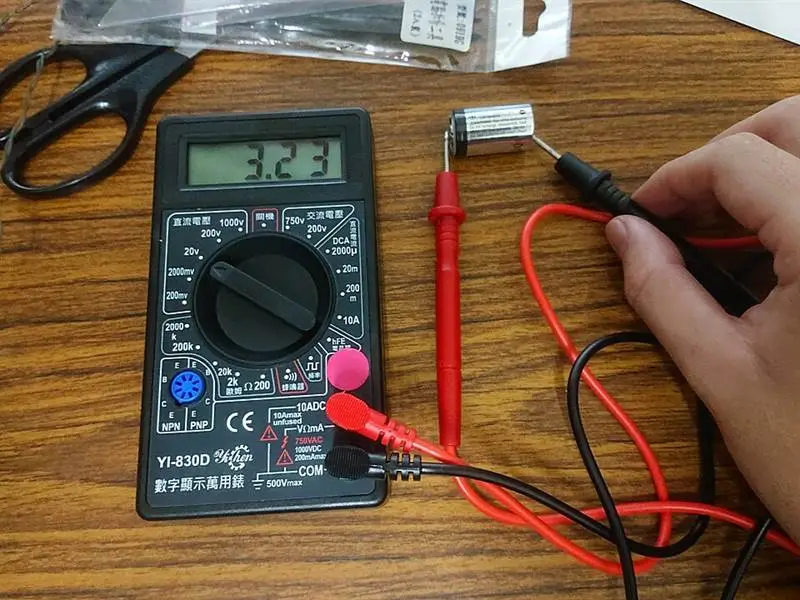
Let the battery rest for a few hours off the charger and with nothing running. Then set a multimeter to DC volts and touch red to + and black to −.
| Reading at rest | What it means |
|---|---|
| 12.6 V or more | Full. Interstate says a full battery makes at least 12.66 V |
| Below 12.4 V | Low. Optima says sulfation starts below 12.4 V, so recharge it soon |
| About 10.5 V and won't charge higher | Likely one dead cell (5 cells × 2.1 V ≈ 10.5 V) |
Optima notes that its YELLOWTOP and most BLUETOP batteries read higher when full, about 13.0 to 13.2 volts. Check your battery's label or maker's site.
How to tell if one cell is bad
- Charge the battery fully, then let it rest.
- Measure the voltage. A reading stuck near 10.5 volts points to one dead cell. The other five are still working.
- On a flooded battery with caps, a hydrometer tests each cell's acid. One cell that reads far lower than the other five is the bad one.
- Watch it charge. On a flooded battery, a cell that bubbles much harder than the others can be the failed one.
You can't fix a dead cell in a sealed battery. Replace it.
Why tool packs say "12V max"
A lithium-ion cell reads higher when it's fresh off the charger and lower under load. Makers label the top number. DeWalt explains it on its battery pages: 12V MAX means 12 volts max with no load, and 10.8 volts nominal. The same thing explains why 20V MAX and 18V packs are the same pack with different labels.
To check a tool pack, see how to test a power tool battery with a multimeter. For runtime, cell size matters, not just the count. Read amp-hours explained, or estimate runtime with our battery runtime calculator.
If your 12V battery reads low
- It reads 12.0 to 12.4 V. It's partly discharged. Charge it fully and test again after it rests.
- It reads fine but won't crank. Check the terminals for white or green crust. See how to clean battery terminals. Then have it load-tested at a parts store.
- It reads about 10.5 V after a full charge. A cell is likely dead. Replace the battery.
- It reads near 0 V. The battery is fully dead or has an internal break. Have it tested, and plan to replace it.
For how different tool brands build their packs, see our guide to power tool battery platforms.
What you'll need
- Digital multimeter: DC volts setting
- Safety glasses and rubber gloves: For any lead-acid battery
- Battery hydrometer: Only for flooded batteries with removable caps
Key takeaways
- Lead-acid 12V batteries (flooded, AGM or gel) have 6 cells. Optima says each should read at least about 2.1 volts when full.
- A full 12V lead-acid battery reads about 12.6 volts at rest. Interstate says at least 12.66. Below 12.4 volts, Optima says sulfation starts.
- A 12V LiFePO4 battery uses 4 cells for 12.8 volts nominal. A 12V MAX tool pack uses 3 lithium-ion cells for 10.8 volts nominal.
- One dead cell takes about 2.1 volts off. A battery stuck near 10.5 volts after charging likely has a dead cell.
- Charging lead-acid batteries gives off hydrogen. Charge them with airflow, caps on, and no sparks or flames nearby.
Questions people ask
How many cells are in a car battery?
Six. A 12-volt car battery has six lead-acid cells in a row. Each makes about 2.1 volts when full, for about 12.6 volts in total.
How many volts is each cell in a 12-volt battery?
About 2.1 volts per cell in a full lead-acid battery. Lithium cells are higher: about 3.2 volts nominal for LiFePO4 and about 3.6 volts nominal for most tool-pack lithium-ion cells.
How many cells are in a 12V lithium battery?
Four for a LiFePO4 battery, the kind sold to replace lead-acid in boats and RVs. Three for a 12V-class power tool pack.
How many cells are in a 6-volt battery?
Three, if it's lead-acid. Three cells at about 2.1 volts each makes about 6.3 volts.
Can one cell in a 12V battery go bad?
Yes. A shorted or dead cell drops the whole battery by about 2.1 volts. If the battery won't charge above about 10.5 volts, one cell is likely gone, and the battery needs replacing.
Sources
- Interstate Batteries: Battery glossary (six cells, 12.66 V full charge)
- Optima Batteries: Basic information on battery voltage (2.1 V per cell, 12.6 V, 12.4 V)
- Battle Born Batteries: 12V LiFePO4 deep cycle battery (12.8 V nominal)
- Sterling Power LP-12150 12V LiFePO4 (4S cell layout)
- DeWalt batteries: 12V MAX = 12 V max initial, 10.8 V nominal
- Panasonic NCR18650B lithium-ion cell data sheet (3.6 V nominal)
- Energizer Nickel Metal Hydride handbook and application manual
- OSHA 29 CFR 1926.441: Batteries and battery charging
Change log: Nov 6, 2026: Rewritten from the 2023 archive post. Answer first; added lithium and tool-pack cell counts, a chemistry table, dead-cell check and OSHA charging safety; removed filler sections.