How to test for voltage with a multimeter, safely
In this guide
- Most likely problems when you test for voltage
- Voltage tester or multimeter: which do you need?
- Check your meter's CAT rating first
- How to test an outlet for voltage
- How to confirm a device is dead before you change it
- Ghost voltage: a reading on a dead wire
- How to test a cord or plug-in tool
- If that didn't work
- When to call a licensed electrician
- What you'll need
- Questions people ask
This guide is part of our electrical hub. New to meters? Start with how to use a multimeter for the dial and the jacks.
Most likely problems when you test for voltage
Most bad results come from the setup, not the wire.
| What you see | What it likely means | The fix |
|---|---|---|
| 0V on an outlet you know works | Wrong dial setting, a lead in the amps jack, or a dead meter | Set AC volts, move the red lead to V, prove the meter on a known outlet |
| A low, wobbly reading on a wire you switched off | Ghost voltage from a nearby live wire | Use LoZ mode if your meter has it; treat the wire as live until you know |
| Non-contact tester stays quiet on a live wire | Shielded cable, thick insulation, a weak battery or a recessed outlet | Don't trust a quiet tester; confirm with the meter |
| Non-contact tester beeps with the power off | It is sensing a field from another wire nearby | Confirm with the meter; see NCVT beeps with no power |
| "OL" on the display | Over the range on a manual meter | Pick a higher range |
| About 120V hot to neutral but near 0V hot to ground | The ground may be missing or broken | Stop. Call a licensed electrician |
Voltage tester or multimeter: which do you need?
You need both, used in order.
A non-contact voltage tester (NCVT) senses the electric field around a live wire. It's fast, and it keeps your hands away from metal. But it can miss voltage.
Fluke's 1AC II sheet lists shielded cable, insulation type, distance, recessed outlets and weak batteries as reasons it may stay silent. Fluke also says a single-pole tester like this is not enough to prove a circuit is safe.
A multimeter touches two points and shows a number. That makes it the tool for the real "is it dead?" answer. OSHA 1910.333 asks for test equipment to verify that parts are dead before work starts.
| Non-contact tester | Multimeter | |
|---|---|---|
| Touches metal? | No | Yes, with the probe tips |
| Gives a number? | No, a beep or light | Yes |
| Can miss voltage? | Yes | Rarely, if it's set and checked right |
| Best use | First scan from a distance | Confirm live or dead |
| Typical range | Fluke 1AC II: 90 to 1000V AC | Up to the meter's rating, often 600V or 1000V |
Check your meter's CAT rating first
A CAT rating tells you how big a voltage spike the meter can survive. A spike that beats the meter can make it fail in your hand. Fluke sorts the places you might test like this:
- CAT II: plug-in loads, appliances, portable tools, and outlets more than 30 ft (10 m) from the panel.
- CAT III: the panel, feeders and short branch circuits near it.
- CAT IV: the service entrance, the meter base and outdoor lines.
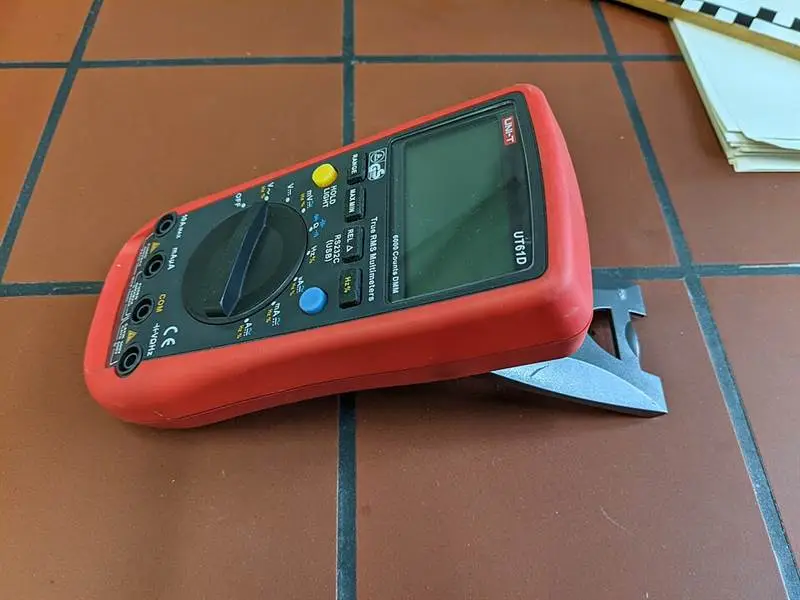
For outlets in a home, use a meter rated at least CAT III 600V. The rating should sit next to the input jacks. Your leads need a rating at least as high as the meter.
Probe shields matter too. Harbor Freight's 59410 manual says its leads are CAT III with the probe covers on and only CAT II with them off. Klein's MM700 manual says to keep the shields on in CAT III and CAT IV spots.
A meter with no CAT rating printed on it doesn't belong on mains power. Use it for batteries and cords only. Our Cen-Tech multimeter guide shows how that plays out on budget meters.
How to test an outlet for voltage
This is the most common home test. Your hands stay on the insulated probe grips, and the outlet's face keeps the live metal out of reach.
Prove the meter works (live)
- Put on safety glasses. Stand on a dry floor.
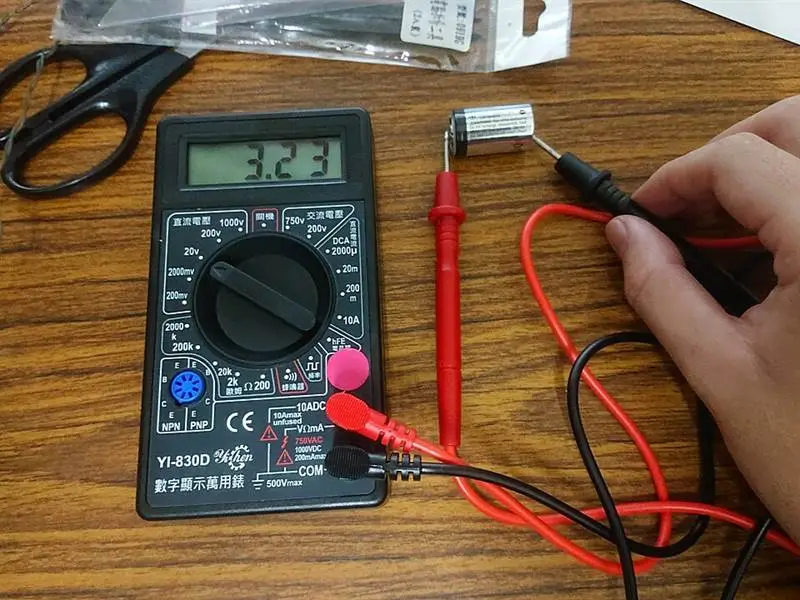
- Black lead in COM. Red lead in V (often marked VΩ). Never use the amps jack for a voltage test.
- Turn the dial to AC volts (V with a wave). On a manual meter, pick the first range above 120V.
- Hold the probes behind the finger guards.
- Insert the probes into the two slots of an outlet you know works. You should see about 120V.
ANSI C84.1 lets the voltage at a 120V service run from 114 to 126V in normal use, which is plus or minus 5% (PG&E's summary of Range A). The standard allows a little more drop inside the house, so an outlet can read a few volts lower.
Test the outlet you care about
- Read hot to neutral: probes in the short (hot) and tall (neutral) slots. Expect about 120V.
- Read hot to ground: one probe in the short slot, one in the round ground hole. Expect about 120V again.
- Read neutral to ground: tall slot to the ground hole. Expect close to 0V.
Prove the meter still works (live again)
Read the known outlet a second time. If the meter doesn't show about 120V now, your test results can't be trusted. This live-dead-live check is what NFPA 70E (2024, section 120.6) asks workers to do. Fluke's safety checklist and Klein's manual say the same.
How to confirm a device is dead before you change it
Say you're swapping a light fixture or an outlet. You switched off the breaker. Now you need proof the power is off before you touch anything.
- Scan first. Hold the non-contact tester near the device. If it beeps, stop. You have the wrong breaker, or a second circuit feeds the box.
- Prove the meter on a known outlet. You should see about 120V.
- Test the device. Read across each pair of wires: black to white, black to ground, white to ground. Touch only the probe tips to the terminals. Every pair should read close to 0V.
- Prove the meter again on the known outlet.
- Only then handle the wires.
If any pair still reads voltage, put the cover back and stop. More than one circuit can share a box. A switch loop or a shared neutral can also keep a wire live. Those are jobs for a licensed electrician.
OSHA's rule says the test should also catch induced voltage and backfeed, even when parts were switched off. That is why you test every pair, not just one.
Ghost voltage: a reading on a dead wire
A wire that's switched off can still show a small, odd reading. This "ghost" comes from a live wire running next to it.
Many digital meters have a high input. Klein's MM700 is 10 MΩ in normal voltage mode, and that lets it pick up the ghost. It also has a LoZ mode that drops the input to about 3 kΩ. A real voltage stays on the display in LoZ, but a ghost reading collapses.
If your meter has no LoZ mode, don't guess. Treat the wire as live and call a licensed electrician to sort it out.
How to test a cord or plug-in tool
You don't need to test a cord live. Unplug it and use a continuity test instead.
- Unplug the cord from the wall.
- Set the meter to continuity or ohms.
- Touch one probe to a plug blade. Touch the other to the matching slot at the far end.
- A beep, or a low reading, means that wire is whole.
Our continuity test guide walks through each wire. For a cordless pack, a DC voltage test is safe and simple. See how many cells in a 12-volt battery for the reading you should expect.
If that didn't work
- The meter reads 0V everywhere, even on the known outlet. Check the dial and the jacks. Then replace the battery and check the fuse. A meter that fails the live check can't be used for a dead check.
- The display jumps around. Push the leads all the way into the jacks. Klein's manual notes that loose leads give unsteady readings.
- The non-contact tester and the meter disagree. Believe the meter only if it passed live-dead-live. If you're still unsure, the circuit stays live until a licensed electrician says otherwise.
- You get voltage on the metal box or the ground wire. Stop. That is a fault, and it can shock you.
When to call a licensed electrician
Call a licensed electrician if you see voltage where there should be none, if hot to ground reads low, or if one breaker doesn't kill the device. Call one for any work in the panel, on the service, or on wires that must stay live. A meter tells you what is there. It doesn't make live work safe.
The meter you own shapes how far you should go. Our Klein MM700 spec guide explains what a CAT IV meter adds. If you have an old needle meter, read how to use an analog multimeter before you put it near an outlet.
Plug-in outlet testers are covered in outlet tester light codes, and the battery runtime calculator helps once you move on to tool packs. Every Klein guide is on the Klein brand page.
What you'll need
- Digital multimeter rated CAT III 600V or higher: The rating sits by the input jacks; a meter with no CAT rating stays off mains power
- Test leads with the same or higher CAT rating: Keep the probe shields on for CAT III work
- Non-contact voltage tester: For the first scan only; it can miss voltage
- A known live outlet: To prove the meter works before and after
- Safety glasses: Arc and spark protection for your eyes
- Dry shoes and a dry floor: Never test while standing in water or on wet ground
Key takeaways
- Treat every wire as live until a working meter proves it is dead. A non-contact tester is a first check, not proof.
- Use a meter and leads rated CAT III (or CAT IV) for the voltage. Look for the rating next to the input jacks.
- Do live-dead-live: read a known live outlet, test your circuit, then read the known outlet again.
- A US outlet should read about 120V hot to neutral and hot to ground, and close to 0V neutral to ground.
- Test only. If a reading is odd, or the job means working on wires, stop and call a licensed electrician.
Questions people ask
Should I use a voltage tester or a multimeter?
Use both. A non-contact tester is quick and tells you to stay away. A multimeter gives you a number and a far more reliable dead reading. Fluke's own tester sheet says a single-pole non-contact tester is not enough to prove a circuit is safe.
What setting do I use to test a 120V outlet?
AC volts. On an auto-ranging meter, pick V with the wave symbol. On a manual meter, pick the first range above 120V, such as 200V or 600V AC.
Can I test a live wire by touching only one probe to it?
No. A multimeter reads the difference between two points, so one probe shows nothing useful. Never hold a bare wire or the metal probe tip to try it.
Why does my meter show voltage on a wire I switched off?
It may be ghost voltage, picked up from a live wire next to it. A meter with a LoZ mode, or a plug-in load, makes a ghost reading drop to near zero. Until you know which it is, treat the wire as live.
Is it safe to test inside my breaker panel?
No, not for a homeowner. Panel and service work sits in a higher CAT zone with much more fault energy. Call a licensed electrician.
Sources
- NFPA 70E, Standard for Electrical Safety in the Workplace (2024), 120.6: verifying absence of voltage (NFPA)
- 29 CFR 1910.333(b)(2)(iv)(B): verify de-energized parts with test equipment; check it before and after on circuits over 600V (OSHA)
- Multimeter guide: CAT II, III and IV explained, plus the meter safety checklist (Fluke)
- Fluke 1AC II VoltAlert instruction sheet: IEC 61010 CAT IV 1000V, 90-1000V AC range, what can stop it from detecting voltage (Fluke, hosted by a reseller)
- Klein Tools MM700 instruction manual: CAT IV leads, LoZ mode, check the meter on a known voltage (Klein Tools, hosted by The Home Depot)
- CEN-TECH 59410 owner's manual: shock warning above 30V AC rms, 42V AC peak or 60V DC; CAT III with probe covers on, CAT II without (Harbor Freight)
- Voltage tolerance: ANSI C84.1 Range A, 114-126V on a 120V service (PG&E)
Change log: Nov 6, 2026: Rewritten from the 2024 archive post. Removed the advice to remove the leads before turning off power and the vague PPE list; added NFPA 70E live-dead-live, OSHA 1910.333, CAT ratings, the non-contact tester's limits and expected outlet readings.