What will a 10,000-watt generator run?
In this guide
- What a 10,000 W generator can run: the chart
- First: is it 10,000 W running or starting?
- How to read the chart
- Worked examples on an 8,000 W running / 10,000 W starting generator
- What a 10,000 W generator usually can't run at once
- Outlets limit what you can plug in
- Fuel and run time
- Safety: read this before you start it
- Other power options
- What you'll need
- Questions people ask
What a 10,000 W generator can run: the chart
All figures are from manufacturer and retailer charts. Running watts keep a device going. Additional starting watts are the short extra spike a motor needs to start, on top of its running watts. Your appliance's nameplate is the better number.
| Device | Running watts | Additional starting watts | Total to start | Source |
|---|---|---|---|---|
| Refrigerator/freezer | 700 | 2,200 | 2,900 | Generac, Lowe's |
| Sump pump, 1/2 HP | 1,050 | 2,150 | 3,200 | Generac |
| Well pump, 1/2 HP | 1,000 | 2,100 | 3,100 | Generac |
| Furnace fan blower, 1/2 HP | 875 | 2,300 | 3,175 | Generac |
| Garage door opener, 1/2 HP | 875 | 2,350 | 3,225 | Generac |
| Washing machine | 1,150 | 2,300 | 3,450 | Generac |
| Microwave, 1,000 W | 1,000 | none | 1,000 | Generac |
| Coffee maker | 1,500 | none | 1,500 | Generac |
| Electric range, one 8" element | 2,100 | none | 2,100 | Generac |
| Space heater | 1,800 | none | 1,800 | Lowe's |
| Window AC, 12,000 BTU | 3,250 | 3,950 | 7,200 | Generac |
| Central AC, 24,000 BTU (2-ton) | 3,800 | 4,950 | 8,750 | Generac |
| Heat pump | 4,700 | 4,500 | 9,200 | Generac |
| Circular saw, 7-1/4" | 1,400 | 2,300 | 3,700 | Lowe's |
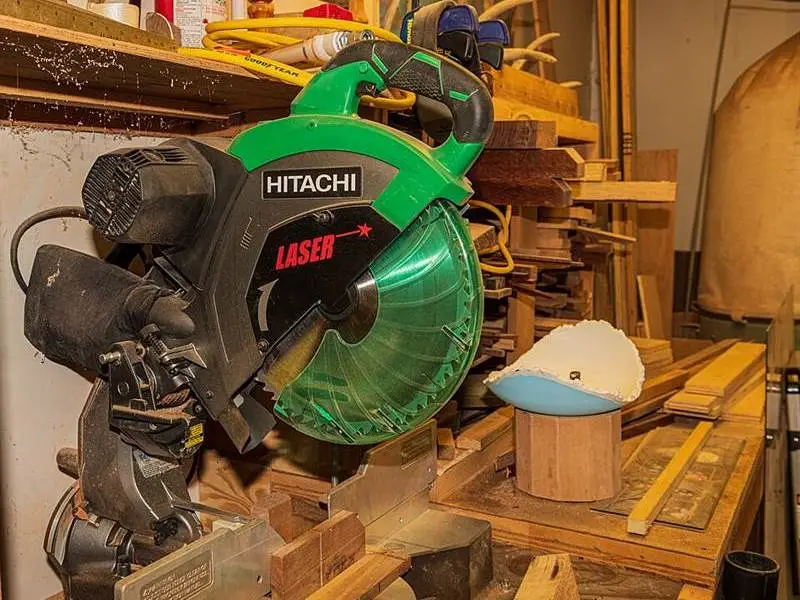
| Miter saw, 10" | 1,800 | 3,300 | 5,100 | Lowe's |
| Table saw, 10" | 2,000 | 2,000 | 4,000 | Lowe's |
| Air compressor, 1 HP | 1,400 | 3,600 | 5,000 | Lowe's |
| Halogen work light | 1,000 | none | 1,000 | Lowe's |
Charts don't agree on every item. Champion lists a refrigerator at 150 to 400 W running plus 800 to 1,200 W to start, much lower than the older figure above. Newer fridges often draw less, so check yours.
To add up your own list, use the generator wattage calculator. It uses the same math as the examples below. More sizing help is in the outdoor power hub and our pillar guide, what size generator do I need.
First: is it 10,000 W running or starting?
Generators list two numbers. Running (rated) watts are what it can supply all the time. Starting (surge) watts are a short burst for starting motors.
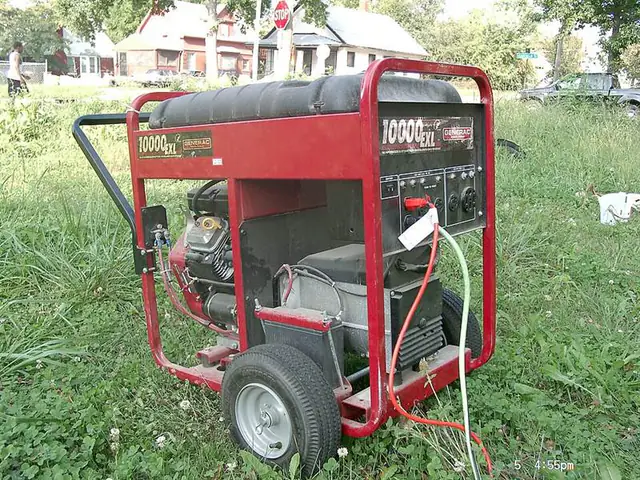
Many generators sold as "10,000 watts" use the bigger, starting number. Generac's GP8000E, for example, is rated 8,000 W running and 10,000 W starting. Plan your loads on the running number. The examples below use those two ratings.
How to read the chart
- Add the running watts of everything you'll run at the same time.
- Find the one device with the biggest additional starting watts. Add that number to the total. Only one motor usually starts at a time, so only the biggest one counts. This is the method in Generac's and Lowe's charts.
- Compare both totals with the generator's running and starting ratings.
- Leave headroom. Our calculator adds 20% to running watts and 10% to the starting total, rounded up to the next 100 W. These are our estimates, not a maker's rule.
Worked examples on an 8,000 W running / 10,000 W starting generator
Example 1: power-outage essentials (fits)
Fridge 700 + sump pump 1,050 + well pump 1,000 + furnace fan 875 + microwave 1,000 = 4,625 W running.
Biggest additional starting load: furnace fan, 2,300 W. Total to start: 4,625 + 2,300 = 6,925 W.
With our headroom: continuous 4,625 × 1.2 = 5,550, so 5,600 W. Surge (4,625 + 2,300) × 1.1 = 7,618, so 7,700 W. Both fit under 8,000 running and 10,000 starting.
Example 2: essentials plus a window AC (too much)
Add a 12,000 BTU window AC: 4,625 + 3,250 = 7,875 W running. Biggest additional start: the AC, 3,950 W. Total to start: 11,825 W.
With headroom: continuous 9,500 W and surge 13,100 W. That's over both ratings. Run the microwave only when the AC is off, or choose a smaller AC. Even then, you're close to the limit.
Example 3: a 2-ton central AC (borderline)
Central AC 3,800 + fridge 700 = 4,500 W running. Additional start: 4,950 W. Total to start: 9,450 W.
With headroom, the surge comes to 10,400 W, over the 10,000 W starting rating. A larger central AC is worse. Generac says a 3-ton unit typically needs 3,500 to 5,000 W running and can need 15,000 to 18,000 W to start. Champion gives a lower range for 3 tons. Read your AC's nameplate, and ask an HVAC pro about a soft-start kit.
Example 4: a jobsite (fits)
Table saw 2,000 + air compressor 1,400 + halogen work light 1,000 = 4,400 W running. Biggest additional start: the compressor, 3,600 W. Total to start: 8,000 W.
With headroom: continuous 5,300 W and surge 8,800 W. It fits. Start the compressor before you start the saw.
What a 10,000 W generator usually can't run at once
- Central AC plus the rest of the house. See example 3.
- Electric water heater, electric dryer and electric range together. These are big 240 V loads. They don't surge, but their steady draw adds up fast. Read each nameplate.
- Several big motors starting at once. If two compressors kick on together, the surge doubles. Stagger them.
Outlets limit what you can plug in
A generator's outlets cap how much power each cord or connection can carry. Generac's GP8000E, for example, has a 30 A, 120/240 V L14-30R outlet and 20 A, 120 V outlets.
- 30 A × 240 V = 7,200 W. That's the most a 30 A L14-30 connection can carry, even if the generator can make more.
- 20 A × 120 V = 2,400 W per 20 A outlet circuit.
Well pumps, central AC and other hard-wired 240 V loads need the 240 V outlet feeding a transfer switch. Our guide to generator plug types explains which outlet is which.
Fuel and run time
Run time depends on the tank size and the load. Generac lists 10 hours at 50% load for the GP8000E. Lighter loads stretch the run time. See generator runtime and fuel use. If you're comparing gas, propane and diesel, see dual-fuel vs gas vs diesel generators.
Safety: read this before you start it
- Keep the generator dry. The CPSC says run it under an open, canopy-like cover on a dry surface.
- Use heavy-duty outdoor cords rated above the load on each cord.
- Turn it off and let it cool before you refuel.
Our full guide is safe generator use: CO, distance and the transfer-switch rule.
Other power options
- For one tool on a truck, an inverter may be enough. See what size inverter to run a circular saw. It uses the same Lowe's circular saw figures as this page.
- For a quieter, cleaner power source, see inverter generator vs conventional.
- For running and starting watts of more tools, see the power tool wattage chart.
What you'll need
- The nameplate watts or amps of each appliance: The label beats any chart
- The generator's running and starting watt ratings: From the spec sheet
- Battery CO alarms in the home: UL 2034 certified, per CPSC
- Heavy-duty outdoor extension cords: Rated above the load on each cord
- Transfer switch or interlock with an inlet: Installed by a licensed electrician, with a permit where required
Key takeaways
- Size by running watts. Some '10,000-watt' generators are 10,000 W starting and 8,000 W running, like Generac's GP8000E.
- Add the running watts of everything that runs at once. Then add the single biggest extra starting load. Only one motor starts at a time.
- Fridge, sump pump, well pump, furnace fan and microwave total about 4,600 W running. That fits with margin.
- Central air is the hard load. Generac says a 3-ton unit can need 15,000 to 18,000 W to start. Many 10,000 W units can't start it.
- Run it outdoors only, at least 20 feet from doors, windows and vents. Never plug it into a wall outlet. Use a transfer switch installed by a licensed electrician.
Questions people ask
Can a 10,000-watt generator run a whole house?
It can run the essentials of many homes: fridge, freezer, sump pump, well pump, furnace fan, lights and some kitchen use. It usually can't run everything at once, and central air or an electric water heater may push it over. To power house circuits, you need a transfer switch installed by a licensed electrician.
Will a 10,000-watt generator run central air?
Sometimes, if the AC is small and little else is running. Generac's chart lists a 24,000 BTU (2-ton) unit at 3,800 W running plus 4,950 W to start. Generac says a 3-ton unit can need 15,000 to 18,000 W to start. Check the AC's nameplate and ask an HVAC pro about a soft-start kit.
What is the best 10,000-watt generator?
We haven't tested any yet, so we won't name one. Compare running watts (not just starting), a 120/240 V outlet that matches your transfer switch, CO shutoff, fuel type, noise rating and the warranty. See inverter generator vs conventional.
Is there a quiet 10,000-watt generator?
Inverter generators are usually quieter than open-frame models, but few reach 10,000 W. Compare the decibel rating on each spec sheet at the same load and distance. See inverter generator vs conventional.
Should I get a 10,000-watt diesel generator?
Diesel makes sense if you already store diesel or need long run times. Diesel portables are less common at this size. Gas, propane and dual-fuel models are easier to find. See dual-fuel vs gas vs diesel generators.
How long will a 10,000-watt generator run on a tank?
It depends on the tank and the load. Generac lists 10 hours at 50% load for its 8,000/10,000 W GP8000E. Check the run-time spec for your model. See generator runtime and fuel use.
Will a 10,000-watt generator run a well pump?
Yes, most 1/2 HP pumps. Generac's chart lists a 1/2 HP well pump at 1,000 W running plus 2,100 W to start. Many well pumps run on 240 V, so they need the generator's 240 V outlet through a transfer switch.
Sources
- GP Series portable generator brochure: wattage reference chart (running and additional starting watts) and GP8000E 8,000/10,000 W specs (Generac)
- What size generator do I need? Sizing guide: central AC starting load and the sizing formula (Generac)
- Portable generator wattage chart: running and additional starting watts (Lowe's)
- What size generator do I need? Appliance running and starting watts (Champion Power Equipment)
- Portable generator hazards: CO, 20-foot rule, backfeeding (U.S. Consumer Product Safety Commission)
- Carbon monoxide information center (U.S. Consumer Product Safety Commission)
Change log: Nov 6, 2026: Rewritten from the 2023 archive post 'best 10000 watt portable generator'. Replaced unsourced product picks with a load guide, manufacturer wattage charts, worked examples and CPSC safety rules.