What is a buzz saw?
In this guide
A buzz saw is a power saw that cuts with a round, toothed blade, also called a circular saw.
That's the dictionary answer. Merriam-Webster's first meaning for buzz saw is "a power saw with a circular cutting blade: circular saw", and it dates the word to 1837. Oxford's learner dictionary marks it as North American English. The name is just the sound: a spinning blade buzzes. For every other saw, start at the cutting hub.
What is a buzz saw used for?
A handheld buzz saw is the go-to saw for fast, straight cuts:
- Crosscutting lumber to length: 2x4s, deck boards, fence boards.
- Ripping plywood, OSB and MDF sheets along their length.
- Bevel cuts for roof rafters and stair parts, with the base plate tilted.
- Plunge cuts into flooring or sheathing, for experienced users.
- Other materials with a special blade: some plastics, thin metal, or masonry with an abrasive or diamond blade.
To keep long cuts straight, see how to cut a straight line with a circular saw. Our wood and MDF page covers blade choice for each sheet type.
Parts of a buzz saw
| Part | What it does |
|---|---|
| Blade | Round steel blade with carbide teeth; 7-1/4 inches on most corded handheld saws |
| Upper guard | Fixed cover over the top of the blade |
| Lower guard | Spring-loaded cover that swings back as you cut, then snaps closed |
| Base plate (shoe) | Flat plate that rides on the work |
| Depth adjustment | Sets how far the blade sticks out below the shoe |
| Bevel adjustment | Tilts the shoe for angled cuts |
| Trigger and lock-off | Starts the saw; the lock-off stops accidental starts |
Types of buzz saws
- Sidewinder (inline) circular saw. The motor sits beside the blade. Light and common. DeWalt's DWE575, a typical corded model, has a 15-amp motor and a 7-1/4-inch blade.
- Worm-drive circular saw. The motor sits behind the blade and drives it through gears. Heavier, with more torque, and popular with framers.
- Cordless circular saw. Runs on a tool battery. Sizes range from small trim saws up to full 7-1/4-inch models.
- Trim or compact saw. Smaller blade for thin stock and one-hand use.
Buzz saw vs other round-blade saws
People also call these "buzz saws", but each one does a different job.
| Saw | How it works | Best at | Portable? |
|---|---|---|---|
| Circular saw (buzz saw) | You push the saw through the work | Straight cuts in lumber and sheets | Yes |
| Table saw | You push the work through a blade sticking up from a table | Accurate, repeat rip cuts | Jobsite models, somewhat |
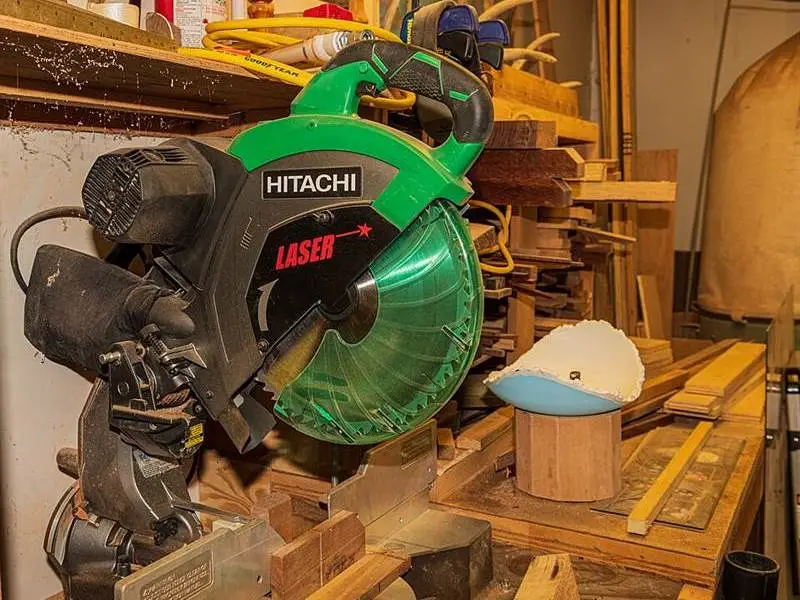
| Miter saw | Blade swings down onto the work | Clean crosscuts and angles in trim and boards | Somewhat |
| Chop saw | Abrasive wheel swings down | Cutting metal pipe and bar | Somewhat |
Band saws, jigsaws and hot saws are not buzz saws. Band saws and jigsaws cut with a straight blade. A hot saw is a racing chainsaw. For a deeper look at the big three, see table saw vs miter saw vs chop saw. For the full list, see types of saws.
How to choose a buzz saw
- Corded or cordless. Corded saws never run out of power. Cordless saws go anywhere. If you plan to run a corded saw off a vehicle or battery, check what size inverter you need for a circular saw or use the inverter size calculator.
- Blade size. 7-1/4 inches is the common size. DeWalt lists 2-9/16 inches of cut depth at 90 degrees for its DWE575, more than the 1-1/2-inch thickness of 2x lumber.
- Sidewinder or worm drive. Sidewinders are lighter. Worm drives have more torque for all-day framing.
- Features. An electric brake stops the blade fast. A dust port, a clear sight line and a solid base plate matter more than extras.
- Blade. DeWalt sells 7-1/4-inch blades with a 5/8-inch arbor in tooth counts like 24 (fast framing) and 60 (cleaner cuts in plywood).
Buzz saw safety
Pinching is a common cause of kickback, when the saw jumps back at you. Our guide to circular saw kickback shows how to set up cuts so it doesn't happen.
Key takeaways
- Buzz saw is an informal North American name for a circular saw. Merriam-Webster dates it to 1837.
- Most people who say buzz saw mean a handheld circular saw. The standard corded size takes a 7-1/4-inch blade.
- A buzz saw is used for straight cuts in lumber and sheet goods. With the right blade, it also cuts some plastics, metal and masonry.
- Table saws, miter saws and chop saws also use round blades. They're sometimes called buzz saws too, but each has a different job.
- OSHA requires guards above and below the base plate on portable circular saws with blades over 2 inches. Never pin the lower guard open.
Questions people ask
Is a buzz saw the same as a circular saw?
Yes. Dictionaries list buzz saw as another name for a circular saw. It's mostly used in the US and Canada.
What does buzz saw mean as a phrase?
To run into a buzz saw means to meet strong, overwhelming opposition. Merriam-Webster lists it as the word's second meaning.
Is a buzz saw a table saw?
Some people use the name for a table saw, because it also has a round blade that buzzes. A table saw is a stationary machine, though, and a circular saw is handheld.
What blade does a buzz saw use?
A handheld circular saw usually takes a 7-1/4-inch blade with a 5/8-inch arbor hole. Fewer teeth (such as 24) cut fast for framing. More teeth (such as 60) cut cleaner for plywood and trim. Always check the blade's max rpm against your saw.
Can a buzz saw cut metal?
Only with a blade made for metal and a saw rated for it. A wood blade on steel is dangerous. Many people use an angle grinder or a metal-cutting circular saw instead.
Is a buzz saw the same as a hot saw?
No. A hot saw is a custom racing chainsaw used in timber sports. It cuts with a chain, not a round blade.
Sources
- Buzz saw: definition and first known use (Merriam-Webster)
- Circular saw: North American English also buzz saw (Oxford Learner's Dictionaries)
- 29 CFR 1910.243: guarding of portable powered tools, incl. circular saws (OSHA)
- DWE575 7-1/4 in. lightweight circular saw specifications (DeWalt)
- 7-1/4 in. 24T carbide circular saw blade, 5/8 in. arbor (DeWalt)
- 7-1/4 in. 60T circular saw blade (DeWalt)
Change log: Nov 6, 2026: Rewritten from the archived post at /power-tools/saw/what-is-a-buzz-saw/. Removed the claim that band saws and jigsaws are buzz saws; added the dictionary definition, saw comparison table, OSHA guard rule and blade basics.