How to cut aluminum: sheet, tube, angle and bar
In this guide
- Pick the tool by shape and thickness
- Before any cut: mark, clamp, wax
- How to cut aluminum on a miter saw
- How to cut aluminum with a circular saw
- How to cut aluminum with a jigsaw
- How to cut aluminum tube and bar with a hacksaw
- How to cut thin aluminum sheet with snips
- Clean up the edge
- Safety and dust
- If that didn't work
- When to call a pro
- Related guides
- What you'll need
- Questions people ask
Aluminum is soft, so it cuts fast. The trouble is that it gums up the wrong blade, grabs thin parts and throws sharp chips. The fix is the right edge for the shape, a clamp and a little wax. This guide is part of our saws and cutting hub.
Pick the tool by shape and thickness
| What you're cutting | Best tool | Blade or edge | Notes |
|---|---|---|---|
| Thin sheet, flashing, gutters | Aviation snips | Straight, left or right cut | Slow on long cuts; see tin snip colors |
| Sheet with curves or holes | Jigsaw | Metal blade; Bosch sells 8 TPI blades for aluminum | Clamp the sheet to a board to stop chatter |
| Small tube, rod, thin bar | Hacksaw | 24 TPI for thin-wall tube, per Klein | Cheap and quiet; slow on thick stock |
| Angle, channel, square tube, trim | Miter saw | Carbide non-ferrous blade, TCG teeth | Cleanest square cuts, if the manual allows aluminum |
| Long straight cuts in plate | Circular saw | 7-1/4 inch non-ferrous blade | Diablo's 56-tooth blade is best at 3/32 to 1/4 inch |
| Rough cuts, one-offs | Angle grinder | Cut-off wheel labeled for aluminum | Most sparks and dust; edges need cleanup |
Planned bench test: 1-inch square tube (1/16-inch wall), 1/8-inch flat bar and 0.032-inch sheet cut with each tool, with 12-inch sheet cuts. Results will be added here when the test is done.
Before any cut: mark, clamp, wax
- Mark the line with a fine marker or a scribe and a square.
- Clamp the work. Short parts must not move. A blade can grab thin aluminum and throw it.
- Wax the blade. Rub stick wax on the teeth before you cut. DeWalt says never apply it to a moving blade.
- Plan the waste side. Let the blade cut on the waste side of the line.
- Clear steel dust. Clean grinding dust from steel out of the area and the vacuum first. The Aluminum Association warns that mixed aluminum and rusty steel dust can react and get hot.
How to cut aluminum on a miter saw
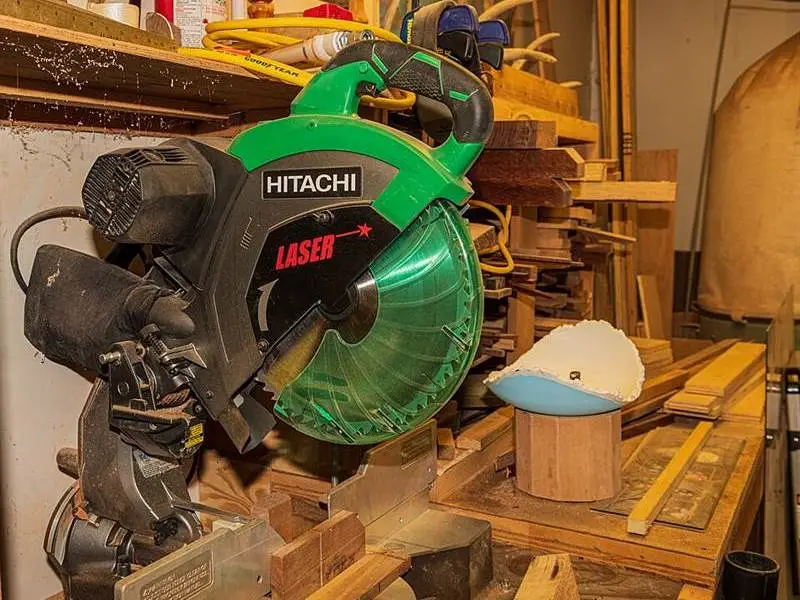
This is the cleanest way to cut angle, channel, tube and trim square.
Pick the blade
Use a carbide blade made for non-ferrous metal, with triple-chip grind (TCG) teeth. DeWalt says to use only TCG blades for non-ferrous metal on its DWS780. For a 10-inch saw, Diablo sells an 80-tooth blade for medium aluminum.
Make the cut
- Unplug the saw and fit the non-ferrous blade.
- Wax the teeth.
- Clamp the piece to the fence and the table.
- Turn extrusions so the blade cuts the thinnest wall first, as DeWalt shows for angle and channel.
- Let the blade reach full speed. Lower it with light, steady pressure.
- Let the blade stop before you lift it.
More on blades, steel and abrasive wheels is in can a miter saw cut metal.
How to cut aluminum with a circular saw
Use this for long, straight cuts in plate and thick sheet.
- Check the saw's manual. If it allows metal, fit a 7-1/4 inch non-ferrous blade.
- Pick the blade for the thickness. Diablo rates its 56-tooth blade for thin (up to 1/8 inch), medium (3/32 to 1/4 inch) and thick (3/16 to 7/16 inch) aluminum. It works best at 3/32 to 1/4 inch.
- Set the blade depth just past the bottom of the plate.
- Support the plate on both sides of the cut so the kerf doesn't close and pinch the blade.
- Clamp a straightedge as a fence. Wax the blade, then cut at a steady pace.
Diablo says it can cut outside its best range with good technique and a lubricant. Expect a slower feed on thick plate.
How to cut aluminum with a jigsaw
A jigsaw cuts curves, holes and odd shapes in sheet.
- Fit a metal-cutting blade. Bosch's T118A metal blade has 17 to 24 TPI. Bosch also sells 8 TPI blades made for aluminum.
- Use finer teeth for thinner sheet, so several teeth touch the metal at once.
- Clamp the sheet to a piece of plywood. The board stops it from shaking and bending.
- Turn off orbital action, or set it low.
- Run the saw at a medium speed and let it cut. Don't force it.
For round holes, the same method from how to cut a circle with a jigsaw works in aluminum. Drill a start hole first.
How to cut aluminum tube and bar with a hacksaw
- Fit a fine blade. Klein lists a 24 TPI blade for thin-wall copper and aluminum.
- Clamp the tube in a vise, close to the cut. Wrap it in a rag so the jaws don't dent it.
- Start the cut with light strokes on the far edge.
- Cut on the push stroke, using the whole blade length.
- Turn the tube as you go so you're always cutting through one wall, not two.
How to cut thin aluminum sheet with snips
Aviation snips are fastest for thin sheet, flashing and gutters.
- Use straight-cut snips for straight lines. Use left- or right-cut snips for curves.
- Make full, long bites, but don't close the jaws all the way at the end of each bite. That leaves a nick.
- Let the waste curl away from the snips.
Clean up the edge
Every cut leaves a burr. File it off, or use a deburring tool on tube ends. Sand flat edges with sandpaper you use only for aluminum. Never reuse paper that has touched steel.
Safety and dust
- Eyes and face. OSHA's eye protection rule covers flying particles. Wear safety glasses, plus a face shield for power saws.
- Dust. The Aluminum Association warns that standard shop vacs can raise the fire risk with fine aluminum dust. Sweep chips up or use a vacuum rated for it.
- Keep metals apart. Don't mix aluminum dust with steel dust. Clean your saw and collector between metals.
- Hands. Gloves help when you carry sharp stock. Take them off near a spinning blade, where they can catch.
If that didn't work
| Problem | Likely cause | Fix |
|---|---|---|
| Chips weld onto the teeth | No lubricant, or a wood blade | Fit a non-ferrous blade and wax it before the cut |
| Blade grabs or jerks | Loose piece, or too few teeth for thin stock | Clamp closer to the cut; use a finer blade |
| Sheet bends and chatters | No support under a jigsaw cut | Clamp the sheet to plywood and cut through both |
| Rough, torn edge | Dull or wrong blade, or feeding too fast | Slow the feed; use a higher tooth count |
| Blade pinches in plate | Kerf closing as the plate sags | Support both sides of the cut |
| Hacksaw teeth strip | Too few teeth touching a thin wall | Switch to a finer blade, such as 24 TPI |
When to call a pro
Get a metal shop to cut it if the plate is thicker than your blade is rated for, you need many identical parts, or the part is safety-critical, like a trailer frame. Shops also offer waterjet and laser cutting for complex shapes.
Related guides
- Cutting steel instead? Read how to cut 1/4-inch steel plate.
- All metals in one place: how to cut metal at home.
- Not sure which saw to buy? Compare table saw vs miter saw vs chop saw.
- Pick a blade for other materials with the circular saw blade guide.
- Need holes, too? See how to drill aluminum. The aluminum material page covers drilling, gluing and fastening it.
What you'll need
- Non-ferrous carbide blade (TCG teeth): Match your saw's diameter, arbor and rpm
- Metal jigsaw blades: Coarse for thick, fine for thin; Bosch sells 8 TPI aluminum blades
- Hacksaw with a 24 TPI blade: For thin-wall tube and small bar
- Aviation snips: For thin sheet and flashing
- Clamps: Two at least; short pieces must not move
- Stick wax lubricant: Keeps chips from sticking to the teeth
- Fine marker or scribe, square: For a clear line
- Metal file or deburring tool: Cut edges are sharp
- Safety glasses (ANSI Z87.1), hearing protection, gloves for handling: No gloves near a spinning blade
Key takeaways
- Pick the tool by the shape: snips for thin sheet, jigsaw for curves, hacksaw for small tube, a non-ferrous blade on a miter or circular saw for straight cuts.
- Use a carbide blade with triple-chip (TCG) teeth made for aluminum. Diablo rates its 7-1/4 inch, 56-tooth blade best for 3/32 to 1/4 inch stock.
- Clamp every piece. Rub stick wax on the teeth before the cut, never on a moving blade.
- Wear safety glasses. Keep aluminum chips and dust apart from steel dust, and don't vacuum fine aluminum dust with a shop vac.
- Check your saw's manual first. Some saws allow aluminum; some allow no metal at all.
Questions people ask
What is the best blade to cut aluminum?
A carbide blade made for non-ferrous metal, with triple-chip (TCG) teeth and a high tooth count. DeWalt says to use only TCG blades for non-ferrous metal on its DWS780 miter saw. Match the diameter, arbor and rpm rating to your saw.
Can you cut aluminum with a wood blade?
Don't. Aluminum loads up wood-blade teeth, and the cut gets rough and grabby. A non-ferrous blade costs less than a ruined part or a kickback.
How do you cut aluminum angle?
On a miter saw with a non-ferrous blade, clamp the angle so the blade cuts the thinnest section first. DeWalt's manual shows this for angle and channel. For a few cuts, a hacksaw works; clamp the piece close to the cut.
How do you cut thin aluminum sheet?
Use aviation snips for short cuts in thin sheet and flashing. For long straight cuts, clamp a straightedge and score and snap very thin sheet, or use a fine metal jigsaw blade. Support the sheet on both sides of the line so it doesn't bend.
Can I cut aluminum with an angle grinder?
Yes, with a cut-off wheel labeled for aluminum. Standard wheels can clog. Use the right guard, wear a face shield, and clean steel grinding dust out of the area first.
Do I need lubricant to cut aluminum?
It helps. Stick wax stops chips from welding onto the teeth. DeWalt says to apply it before the cut and never to a moving blade. Diablo says a lubricant helps when you cut stock outside the blade's best range.
Sources
- Diablo D0756N 7-1/4 in. x 56-tooth aluminum blade: thin, medium and thick ranges; best 3/32 to 1/4 in
- Diablo D1080N 10 in. 80-tooth medium aluminum blade
- DEWALT DWS780 instruction manual, US edition: TCG blades for non-ferrous metal, stick wax, extrusion position (via ManualsLib)
- Bosch T-shank jig saw blades for metal: T118A (17-24 TPI) and 8 TPI blades for aluminum
- Klein Tools compact medium cut hacksaw: 24 TPI blade for thin-wall copper and aluminum
- Aluminum Association: aluminum dust in automotive collision repair (no shop vacs on fine dust, never mix with steel dust)
- OSHA 29 CFR 1910.133: eye and face protection
Change log: Nov 6, 2026: Rewritten from the 2023 archive post. Removed the claims that a table saw and chop saw are ideal for aluminum and that a jigsaw cuts thick aluminum 'with ease'; added the tool-by-shape table, blade specs from Diablo, DeWalt, Bosch and Klein, and the aluminum dust rules.