How to remove a spanner nut without the spanner wrench

In this guide
A spanner nut has no flats for a normal wrench. It has holes or slots, and the matching spanner wrench has pins or a hook that fit them.
Lose that wrench and the nut seems stuck for good. It isn't. You just need a tool that grips the holes or the round edge. More stuck-fastener fixes are in the fasteners hub.
Which spanner nut do you have?
| Nut | Where you find it | What it looks like | Best no-wrench fix |
|---|---|---|---|
| Grinder flange nut (lock nut) | Holds the disc on an angle grinder | Round, two holes on the face | Spindle lock + pliers in the holes or a strap wrench |
| Faucet mounting nut | Under the sink, on the faucet shank | Large, often plastic, with wings or slots | By hand, then a basin wrench |
| Slotted or pin ring nut | Pumps, bike parts, shocks, bearing housings | Round, with notches on the edge or holes on the face | Strap wrench, or pliers in the holes |
If you're not sure, look at the faces of the nut. Two holes on top means a pin (face) spanner. Notches around the edge mean a hook spanner.
Methods compared
| Method | Works on | Difficulty | Risk | Speed |
|---|---|---|---|---|
| Snap ring or needle-nose pliers in the holes | Grinder nuts, pin ring nuts | Easy | Low if the tips seat fully | Fast |
| Strap wrench or rubber filter wrench | Any round nut you can reach | Easy | Very low; doesn't mar | Fast |
| Basin wrench | Faucet nuts under a sink | Medium | Low | Medium |
| Locking or slip-joint pliers on the edge | Last resort, any nut | Easy | Scars the nut | Fast |
| Hammer and screwdriver in a hole or slot | Don't | — | High: slips, chips, damages the tool | — |
Method 1: angle grinder flange nut
The flange nut clamps the disc against an inner flange. You'll swap discs often if you grind or cut metal, as in cutting 1/4-inch steel plate.
Makita ships a lock nut wrench with its grinders for this job. The GA4530, for example, comes with one. Without it, here's what to do.
- Unplug the grinder or take out the battery. Never work on a grinder that can start.
- Press the spindle lock and turn the disc by hand until the lock clicks in. Makita's manuals say to press the shaft lock so the spindle can't turn, and never to press it while the spindle is moving.
- Try hand-loosening first. Wear a glove, hold the lock, and turn the disc counterclockwise. Sometimes the disc alone gives enough grip.
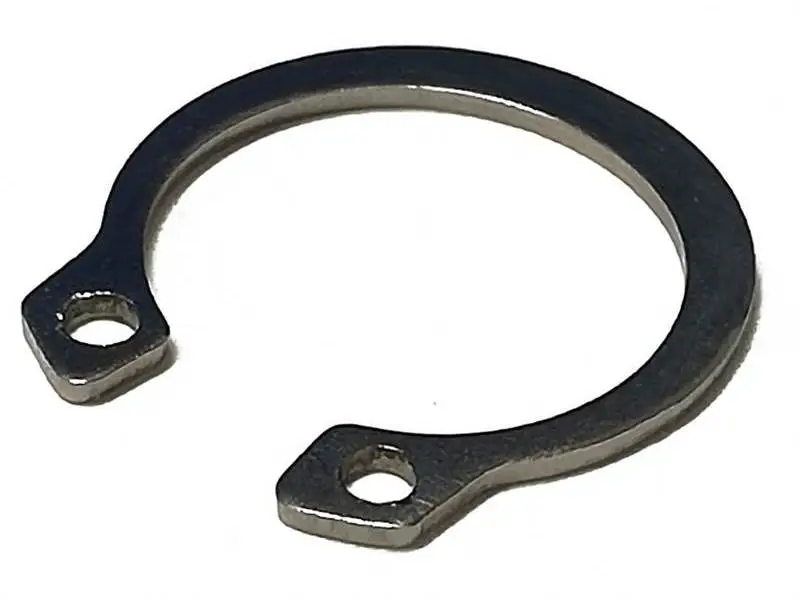
- Pliers in the holes. Put the tips of snap ring pliers or thin needle-nose pliers into the two holes. Open the pliers so the tips press outward and bite. Turn counterclockwise.
- Strap wrench. If the holes are worn, wrap a strap wrench or a rubber oil-filter wrench around the nut, or around the disc if it's still whole, and turn.
The tips must sit all the way in the holes. Tips that sit halfway will slip and round the holes. Our snap ring removal guide shows how to seat tips firmly.
Method 2: faucet mounting nut under the sink
People often call the big nut that clamps a faucet to the sink a spanner nut. Many are plastic, with wings or slots for a special tool.
- Shut off the water and open the faucet to drain it.
- Try your hand first. Plastic nuts often turn by hand once you can reach them.
- Use a basin wrench. Moen's faucet guide names the basin wrench as the tool for old mounting nuts. Its long shaft reaches up behind the bowl. See what is a basin wrench for how to set the jaw.
- Stuck plastic nut? Moen says a hair dryer can soften it. Warm it, then turn again.
- Slotted Moen-style nut? Some Moen faucets come with a plastic install tool that slides over the nut. You turn it with a screwdriver through its hole. If you have the tool, use it.
If the nut is corroded metal and won't move, a pro may cut it off. That's quicker than breaking the sink.
Method 3: slotted or pin ring nut
These show up on pumps, bike parts and some machines.
- Holes on the face: use pliers in the holes, as in Method 1.
- Notches on the edge: wrap a strap wrench around the outside. Its grip spreads over the whole edge, so it won't chew the notches.
- Rusted: soak it with penetrating oil and give it time. Our rusted bolt guide covers stubborn threads.
If the edge is already chewed up, treat it like a rounded nut. See how to remove a rounded bolt or nut.
Why not a hammer and screwdriver?
You'll see this tip a lot: set a screwdriver in a hole and tap it around with a hammer. Skip it.
- The screwdriver slips out and rounds the holes or slots.
- Hardened steel can chip when struck. Chips fly at your eyes.
- On a grinder, each blow shocks the spindle lock and the gears inside.
Steady force from pliers or a strap wrench works better and keeps the nut usable. The same rule applies to other stuck hardened parts, like a broken drill bit. Our steel material page explains why hard steel chips instead of bending.
When to just buy the wrench
Buy one if you use the tool often. A replacement grinder lock nut wrench costs little from the maker.
An adjustable pin spanner fits many hole spacings. For sinks, a basin wrench pays off on the first faucet swap. And if a screw is the problem, not a nut, see how to remove a stripped screw.
Safety
What you'll need
- Safety glasses and work gloves: Always
- Snap ring pliers or needle-nose pliers: Tips go in the pin holes
- Strap wrench or rubber oil-filter wrench: Grips round nuts without marring
- Basin wrench: For nuts under a sink
- Adjustable pin spanner (optional): Cheap, fits many sizes
- Penetrating oil: For rusted metal nuts
- Hair dryer: For stuck plastic faucet nuts
Key takeaways
- A spanner nut is a round nut with holes or slots instead of flats. You turn it with pins or hooks, not jaws.
- On a grinder, unplug the tool or pull the battery, then press the spindle lock. Makita warns never to press it while the spindle is turning.
- Snap ring pliers or needle-nose tips in the two holes work as a pin wrench. A strap wrench grips the outside edge.
- Faucet mounting nuts turn with a basin wrench. Moen says a hair dryer can soften a stuck plastic nut.
- Don't tap a screwdriver with a hammer to turn the nut. It chews up the holes, and hardened steel can chip.
Questions people ask
How do I get a grinder nut off without the spanner?
Unplug the grinder or remove the battery. Press the spindle lock and turn the spindle until it locks. Put snap ring plier tips in the nut's two holes, or wrap a strap wrench around it, and turn counterclockwise.
Can I use a hammer and screwdriver on a spanner nut?
Avoid it. The screwdriver slips, rounds out the holes and can chip. On a grinder, the shock goes into the spindle lock and gears. Use pliers in the holes or a strap wrench instead.
Which way do you turn a spanner nut to loosen it?
Counterclockwise, viewed from the nut's face, for standard right-hand threads. On a grinder, look at the nut from the disc side while you hold the spindle lock.
What is a spanner nut on a faucet?
It's the large nut under the sink, or on the faucet body, that clamps the faucet to the sink. Some are plastic with wings or slots. A basin wrench reaches it in the tight space behind the bowl.
What tool replaces a lost grinder spanner?
A new lock nut wrench from the grinder's maker is cheap. Makita lists one (782424-9) with its GA4530. An adjustable pin spanner or a quick-locking nut, like Bosch's SDS clic for M14 grinders, also helps.
Sources
- Makita XAG03Z cordless angle grinder instruction manual: shaft lock and lock nut wrench
- Makita GA4530 angle grinder: included lock nut and lock nut wrench (782424-9)
- Bosch Professional: SDS clic quick-locking nut M14
- Moen: DIY kitchen faucet installation guide (basin wrench, hair dryer on plastic nuts)
- Moen installation sheet INS10578: mounting nut install tool turned with a screwdriver
- OSHA eye and face protection (29 CFR 1910.133)
Change log: Nov 6, 2026: Rewritten from the 2024 archive post. Removed the hammer-and-screwdriver method; added a nut-type table, grinder steps from the Makita manual, faucet nuts from Moen, and safety.