Types of screwdrivers (PH, PZ, Torx, Robertson) and which bit fits
In this guide
- What is a screwdriver?
- The 6 screwdriver types at a glance
- Slotted screwdrivers: cabinet vs keystone tip
- Phillips vs Pozidriv: the mix-up that strips screws
- Square (Robertson) screwdrivers
- Torx screwdrivers and their cousins
- Other screwdriver builds you'll see
- Screwdriver vs drill/driver vs impact driver
- How to choose the right screwdriver
- Build a basic screwdriver kit
- What you'll need
- Questions people ask
What is a screwdriver?
A screwdriver is a hand tool with a handle, a steel shaft and a shaped tip that fits into a screw head to turn it. The tip shape is the "type." The tip size has to match the screw too.
- Handle: where you grip and push. A bigger handle gives more torque.
- Shaft (shank): sets the reach. Long shafts reach deep screws; stubby ones fit tight spaces.
- Tip: the business end. It must match the screw's recess.
The 6 screwdriver types at a glance
| Type | Tip shape | How to spot the screw | Common sizes | Where you'll find it |
|---|---|---|---|---|
| Slotted (flat) | Flat blade | One straight slot | Sized by blade width, e.g. 3/16 and 1/4 in | Old hardware, outlet covers, electrical terminals |
| Phillips (PH) | Cross with tapered flanks | Plain cross | #0 to #4; #1 and #2 most used | Most household screws, drywall screws |
| Pozidriv (PZ) | Cross with straight flanks | Cross plus 4 thin lines between the arms | PZ1, PZ2, PZ3 | European furniture and cabinet hardware |
| Square (Robertson) | Square peg | Square hole | #1 green, #2 red, #3 black | Decking, cabinets, Canadian builds |
| Torx (star) | Six rounded lobes | Six-point star | T-numbers, e.g. T15, T20, T25 | Deck screws, appliances, cars |
| Hex (Allen) | Six-sided | Hex hole | Inch and metric sets | Furniture, bike parts, set screws |
A printable version is on the screw drive chart.
Slotted screwdrivers: cabinet vs keystone tip
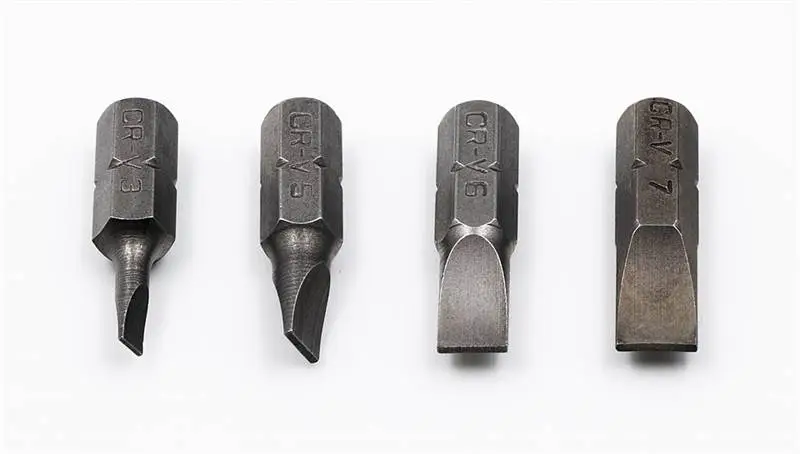
- Keystone tip: the blade flares a little wider than the shaft. More grip on an open slot.
- Cabinet tip: the blade is the same width as the shaft. Klein Tools describes it as a narrow tip for tight spaces, so it reaches screws sunk in a hole.
Pick a blade that fills the slot's length and width. A blade that's too narrow twists out and chews the slot.
Phillips vs Pozidriv: the mix-up that strips screws
These two look alike, but they aren't the same.
- Phillips (PH): the flanks taper toward the tip, PB Swiss Tools explains. Under hard torque, that taper pushes the driver up and out. That's cam-out.
- Pozidriv (PZ): the flanks are parallel, so the driver stays seated. Pozidriv screws have four extra thin lines stamped between the cross arms.
Which fits which? PB Swiss Tools says a Phillips driver fits a Pozidriv screw but with some play. A Pozidriv driver won't seat in a Phillips screw. When in doubt, use Phillips.
Square (Robertson) screwdrivers
A square tip locks into a square recess and rarely slips. Many brands use the same color codes: green for #1, red for #2 and black for #3. McFeely's lists the green #1 for #5 to #7 screws.
Torx screwdrivers and their cousins
Torx has six rounded lobes. Its drive angle is 15 degrees, per the Torx Plus maker's brochure, which grips far better than a Phillips cross.
- Tamper-resistant Torx (TR): a pin sits in the middle of the recess. You need a bit with a hole in its tip.
- Torx Plus: squarer lobes with a 0° drive angle. The brochure says this nearly eliminates camout. Torx Plus screws need Torx Plus bits.
Other screwdriver builds you'll see
- Multi-bit driver: one handle, many 1/4-inch hex bits stored in it. Good first pick for a home kit.
- Stubby: a very short shaft for tight spots.
- Precision: tiny tips for glasses, electronics and toys.
- Ratcheting: turns the screw without regripping the handle.
- Insulated: rated for work near live parts. Klein's 1000 V drivers meet IEC 60900 and ASTM F1505.
- Impact bits: made to take the hammering of an impact driver. Regular bits can snap.
Screwdriver vs drill/driver vs impact driver
- Screwdriver: most control, no risk of over-driving. Best for small screws, hinges and outlet covers.
- Drill/driver: fast, with a clutch to stop at a set torque. Best for most wood and drywall screws.
- Impact driver: high torque in short bursts. Best for long screws and lag bolts. Use impact-rated bits.
How to choose the right screwdriver
- Match the shape. Look closely at the head. Thin lines between the cross arms mean Pozidriv.
- Match the size. The tip should fill the recess with no wobble.
- Push in, then turn. With too little push, a Phillips tip cams out and chews the head.
- Replace worn tips. A rounded tip slips even in the right screw.
Stuck with a chewed-up head? See how to remove a stripped screw. If the screw won't bite at all, read screw won't go into the wall. Want the tip to hold the screw? Learn how to magnetize a screwdriver.
Build a basic screwdriver kit
Klein Tools sells a 7-piece set of what it calls the most frequently used, general-purpose screwdrivers: three cabinet tips, two keystone tips, and #1 and #2 Phillips. Add a #2 square and a few Torx bits and you'll cover almost every home job.
For the rest of the kit, see tools every homeowner needs, types of pliers and types of wrenches. Multi-tools carry small drivers too: see what is an awl on a multi-tool. More hand-tool guides are in the hand tools hub.
What you'll need
- Slotted: a small and a medium cabinet or keystone tip: Cover most slots
- Phillips #1 and #2: #2 does most household jobs
- Square #1 and #2: Decking, cabinets and many outlet screws
- A set of Torx bits: Deck screws, appliances, cars
- Multi-bit driver or 1/4 in hex bit holder: Covers odd sizes with bits
Key takeaways
- Match the tip to the recess shape, then the size. The wrong tip slips (cams out) and strips the head.
- Phillips (PH) and Pozidriv (PZ) look alike. Pozidriv screws have extra thin lines between the cross arms. PB Swiss Tools says a PZ driver won't seat in a Phillips screw.
- Square (Robertson) drivers are color coded on many brands: green #1, red #2, black #3.
- Torx has six rounded lobes and grips well. Tamper-resistant Torx has a pin in the center and needs a hollow bit.
- Near anything that could be live, use a driver rated 1000 V to IEC 60900 or ASTM F1505. Turn the breaker off and test the circuit first.
Questions people ask
What are the main types of screwdrivers?
Slotted (flat), Phillips, Pozidriv, square (Robertson), Torx and hex (Allen). You'll also see security types like tamper-resistant Torx, and builds like stubby, precision, ratcheting and insulated drivers.
What is the most common screwdriver size?
A #2 Phillips. It fits many household screws, from cabinet hinges to switch plates. Klein Tools counts #1 and #2 Phillips among the most frequently used tips.
Can I use a Phillips screwdriver on a Pozidriv screw?
It fits, but loosely. PB Swiss Tools says a Phillips driver has some play in a Pozidriv screw. A Pozidriv driver won't seat properly in a Phillips screw. If you're not sure which you have, use Phillips.
What is a Robertson screwdriver?
A square-tip driver for square-recess screws, common in Canada and in decking and cabinet screws. Many brands color code the handles: green #1, red #2, black #3.
Is Torx better than Phillips?
Torx grips better and is less likely to slip out under torque, which is why many deck and structural screws use it. Phillips is still the most common head on household screws.
What is a cabinet tip screwdriver?
A slotted screwdriver whose blade is no wider than its shaft, so it can reach screws sunk in a hole without scraping the sides. A keystone tip flares wider than the shaft for more grip on open slots.
Do I need an insulated screwdriver?
Only for work near live electrical parts. Look for a 1000 V rating to IEC 60900 or ASTM F1505. Even then, turn off the breaker and test the circuit before you touch it.
Sources
- Phillips and Pozidriv cross-head screws explained: tapered vs parallel flanks, fit and cam-out (PB Swiss Tools)
- Screwdriver set, slotted and Phillips, 7-piece: the most frequently used tips and sizes (Klein Tools)
- Insulated screwdriver, #2 Phillips: 1000 V rated to IEC 60900 and ASTM F1505 (Klein Tools)
- Square drive screw and driver: color-coded sizes, #1 green fits #5 to #7 screws (McFeely's)
- TORX PLUS drive system brochure: 15° TORX drive angle vs 0° TORX PLUS, camout (Stanley Engineered Fastening, an Acument licensee)
Change log: Nov 6, 2026: Rewritten from the 2023 archive post 'Different types of screwdrivers'. Added the drive-type fit table, Phillips vs Pozidriv test, square color codes, Torx variants and insulated-driver standards; removed filler.